In the fast-paced world of texting and online communication, abbreviations and shorthand have become a vital part of everyday conversation.
One term that frequently appears across messages, social media, and dating apps is “ditto.” People often encounter it and wonder about its precise meaning, context, and appropriate usage.
Understanding what “ditto” means in text can improve your comprehension of digital communication, prevent misunderstandings, and even help in forming more accurate responses.
Whether you’ve seen it in a casual chat with friends or in a professional online forum, this article explores the meaning, history, and various ways “ditto” is used.
By the end, you will be able to confidently recognize, interpret, and respond to this term in multiple digital settings.
Definition & Meaning
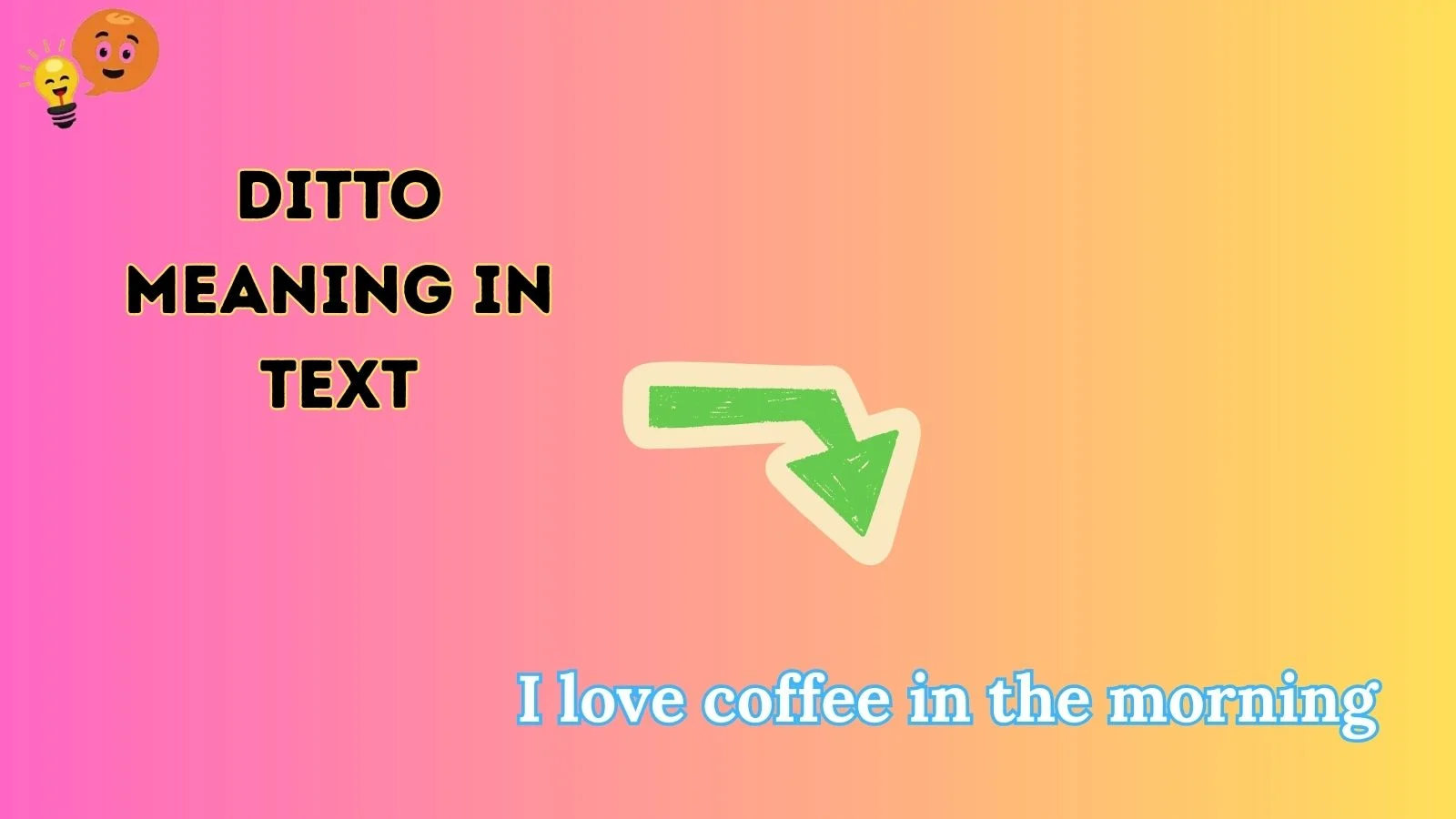
“Ditto” in text is commonly used to indicate agreement, repetition, or mirroring of a previous statement. Essentially, it is a shorthand way of saying “same here” or “I feel the same.” For example, if someone writes, “I love coffee in the morning,” responding with “ditto” expresses that you share the same sentiment without restating it fully. Its use saves time, makes conversations concise, and often conveys a casual, friendly tone. In text messages, chat apps, or social media comments, “ditto” is a simple and efficient way to echo agreement while keeping the interaction brief and natural.
Background & History
The word “ditto” originates from the Italian word “detto,” meaning “said,” which was adapted into English in the early 17th century. Historically, it was used in written documents to avoid repeating words or phrases, marked by a symbol resembling two quotation marks. In modern communication, especially in the digital era, “ditto” has evolved from a practical notation into a casual expression of agreement in texts, online chats, and instant messaging platforms. Its continued popularity demonstrates how historical linguistic tools adapt to contemporary communication styles.
Usage in Various Contexts
“Ditto” can be used in multiple contexts:
- Casual conversation: Expressing agreement with a friend’s statement.
- Professional communication: Occasionally used in emails or reports to indicate repetition of data or approval.
- Social media: Often in comment sections to show alignment with previous posts.
- Dating apps: Users might employ “ditto” to quickly express interest or shared preferences.
It is versatile and works well in short, informal responses, but caution is advised in formal contexts where clarity is critical.
Common Misconceptions & Clarifications
Many people mistakenly think “ditto” is exclusive to romantic contexts or implies excessive enthusiasm. In reality, it is neutral and can be applied in any setting to denote agreement or repetition. Another misconception is that it requires a prior statement; however, “ditto” can also stand alone when the context is clear, making it efficient for quick responses.
Similar Terms & Alternatives
Other phrases that convey a similar meaning include:
- “Same here”
- “Me too”
- “Likewise”
- “Agreed”
While these alternatives are contextually similar, “ditto” often carries a more casual and concise tone.
How to Respond to This Term
Responding to “ditto” depends on the context:
- Friendly chat: Simply continue the conversation or share a related thought.
- Professional setting: You may restate agreement formally or acknowledge with “Noted” if appropriate.
- Dating or social apps: You can reciprocate with a positive comment or emoji to maintain engagement.
Regional or Cultural Differences
The interpretation of “ditto” can vary by region. In Western countries, it is widely recognized as casual agreement. In some non-English-speaking regions, it may be less familiar, requiring explanation. Awareness of your audience ensures effective communication and avoids confusion.
Comparison with Similar Terms
Compared to “me too” or “same here,” “ditto” is slightly more versatile in brevity and neutrality. Unlike “likewise,” which can sound formal, “ditto” is more casual and friendly, making it suitable for texting or online chat scenarios.
Usage in Online Communities & Dating Apps
In forums, social media, or dating apps, “ditto” is often used to express mutual interests, shared feelings, or agreement without lengthy replies. Its convenience makes it a favorite for users who prefer quick and concise interaction. In dating apps, it can indicate shared hobbies or attraction in a lighthearted, non-intrusive manner.
Hidden or Offensive Meanings
Generally, “ditto” has no offensive or hidden connotations. However, overuse or sarcastic application could be misinterpreted as dismissive. Users should consider tone and context to avoid misunderstandings.
Suitability for Professional Communication
While “ditto” is acceptable in informal professional communication (like team chats), it is less suitable for formal emails, reports, or documents. Using “ditto” in such contexts might appear too casual or ambiguous; instead, formal alternatives like “agreed” or “as above” are recommended.
FAQs:
What does “ditto” mean in texts?
It indicates agreement or repetition of a previous statement.
Can “ditto” be used professionally?
Yes, but only in informal professional chats, not formal documents.
Is “ditto” rude or offensive?
No, it’s neutral; context determines tone.
Are there alternatives to “ditto”?
Yes, phrases like “me too,” “same here,” and “likewise” are common.
Can “ditto” be used alone?
Yes, it can stand alone if context is clear.
Where is “ditto” most commonly used?
Text messages, social media, online forums, and dating apps.
Conclusion:
“Ditto” is a versatile, concise term widely used in texting and online communication to express agreement, repetition, or shared sentiment.
Understanding its origin, usage, and context can enhance your digital conversations and help avoid misinterpretations.
Whether in casual chats, online communities, or dating apps, using “ditto” appropriately allows for smoother interactions and clearer communication.
Being aware of its professional limitations ensures it is applied correctly across various contexts.
With this knowledge, you can confidently recognize, interpret, and respond to “ditto” in any digital environment.

Jhool Brooks is an innovative professional recognized for blending creativity with strategic insight. With expertise in [insert industry, e.g., technology, marketing, business development], he consistently develops solutions that drive growth, efficiency, and impact. Known for his problem-solving mindset and forward-thinking approach, Jhool excels at turning challenges into opportunities. His dedication to excellence and innovation makes him a trusted leader and collaborator in every project he undertakes.