In today’s fast-paced digital communication, short forms and abbreviations have become a norm. One of the most common yet often misunderstood terms is “k”.
People frequently encounter this single-letter message in texts, chats, and social media conversations, and many wonder about its meaning and the tone behind it.
While it seems simple, “k” in text can convey different emotions depending on the context, from agreement to disinterest.
Its widespread use spans texting apps, online communities, and even dating platforms. Understanding what “k” means in text is crucial for avoiding miscommunication and ensuring your responses align with the intended tone.
Whether you’re a casual texter, professional communicator, or someone navigating social media, knowing the nuances of “k” can help you interpret messages accurately and respond appropriately.
Definition & Meaning
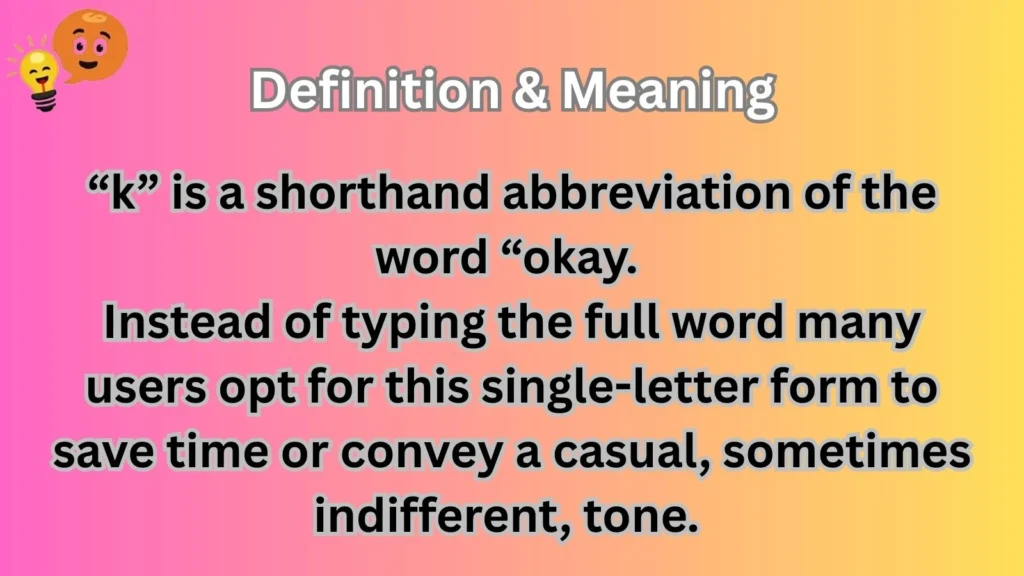
“k” is a shorthand abbreviation of the word “okay”. Instead of typing the full word, many users opt for this single-letter form to save time or convey a casual, sometimes indifferent, tone. Although it is essentially a positive acknowledgment, the tone can vary:
- Neutral acknowledgment: Simply agreeing with what was said.
- Indifference or curt response: Can suggest the sender is disinterested or annoyed.
- Quick confirmation: Used in fast-paced texting to acknowledge receipt of a message.
In essence, “k” in text is versatile but highly context-dependent. Its brevity has made it both convenient and controversial, as many readers interpret it differently.
Background & History
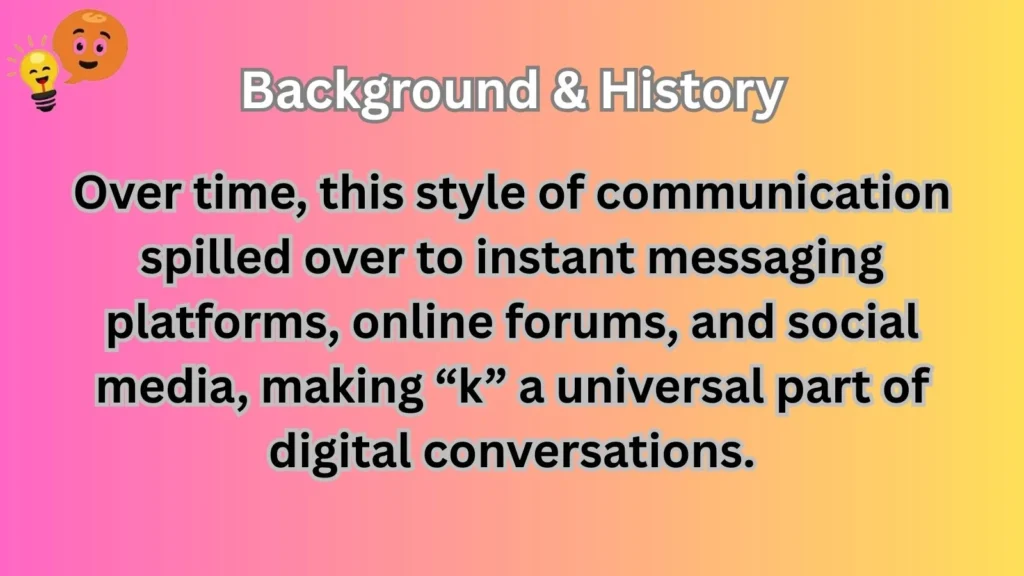
The use of abbreviations like “k” traces back to the early days of SMS messaging, when character limits forced users to find shorter ways to communicate. In the 1990s, mobile texting became widespread, and shorthand like “u” for “you,” “r” for “are,” and “k” for “okay” gained popularity. Over time, this style of communication spilled over to instant messaging platforms, online forums, and social media, making “k” a universal part of digital conversations.
The single-letter version likely became popular because it’s the fastest way to acknowledge a message, reflecting the digital era’s demand for speed and efficiency. Its brevity also contributes to its ambiguity, leading to debates about whether it comes across as polite or rude.
Usage in Various Contexts
“k” can appear in a wide range of communication contexts:
- Text messaging: Quick acknowledgment of plans or information.
- Social media: Brief responses to comments or posts.
- Work chats: Sometimes seen in professional communication, though often discouraged due to perceived rudeness.
- Dating apps: Used to signal agreement or minimal interest, which can be misinterpreted by the recipient.
The interpretation of “k in text” heavily depends on the relationship between the sender and recipient, the tone of previous messages, and the platform being used.
Common Misconceptions & Clarifications
Many people assume that sending “k” is always rude or dismissive, but this is not universally true. Misunderstandings often arise because tone cannot be conveyed through text alone. Other misconceptions include:
- “k” is lazy: Sometimes it’s simply a time-saving tool.
- “k” signals anger: It may just indicate neutrality.
- It’s inappropriate everywhere: In casual chats, it’s widely acceptable.
Recognizing the context and sender’s typical communication style is key to interpreting “k” accurately.
Similar Terms & Alternatives
Several terms can be used instead of “k”, depending on the tone you want to convey:
- “ok” – slightly more formal than “k”
- “okay” – full acknowledgment
- “alright” – friendly and neutral
- “yep” – casual and affirmative
- Emoji-based responses (👍, 🙂) – convey agreement or acknowledgment without words
How to Respond to This Term
Responding to “k” can be tricky due to its ambiguous tone. A few strategies:
- Mirror the tone: Reply with another short acknowledgment if the conversation doesn’t require elaboration.
- Seek clarification: If unsure, ask for confirmation politely.
- Add context or emoji: Lightens the tone and avoids misunderstandings.
Regional or Cultural Differences
While “k” is widely understood in English-speaking countries, cultural interpretations may differ:
- United States & UK: Often neutral or slightly curt.
- Asia: Could be interpreted as casual acknowledgment without negative connotations.
- Professional environments worldwide: Generally avoided in formal emails or business chats.
Understanding regional usage can help avoid miscommunication, especially in multicultural conversations.
Comparison with Similar Terms
“k” vs “ok” vs “okay”:
| Term | Tone | Context |
|---|---|---|
| k | Casual, ambiguous | Texting, social media |
| ok | Neutral | Texts, casual professional chats |
| okay | Friendly, formal | Longer messages, professional use |
Usage in Online Communities & Dating Apps
In online communities, “k” is often seen as a neutral acknowledgment or a quick reaction. On dating apps, its reception can vary:
- Positive: Shows acknowledgment without overcomplicating the conversation.
- Negative: May seem uninterested or dismissive, depending on the other person’s expectations.
Understanding the context of the platform is key when interpreting “k”.
Hidden or Offensive Meanings
While rarely offensive, “k” can be interpreted as passive-aggressive, especially when responding to emotional or important messages. Tone, timing, and previous interactions influence whether it feels polite or curt.
Suitability for Professional Communication
Using “k” in professional communication is generally discouraged. It can come across as lazy or indifferent. Opting for “ok” or “understood” is safer for emails, workplace chats, or client conversations.
FAQs:
What does “k” mean in text messages?
It’s a shorthand for “okay,” usually indicating agreement or acknowledgment.
Is “k” rude to send?
Not always. Tone and context determine if it’s neutral or curt.
Can “k” be used professionally?
It’s better to use “ok” or “understood” in professional settings.
Why do people use “k” instead of “ok”?
It’s faster and more casual, suited for texting or instant messaging.
What’s the difference between “k” and “ok”?
“K” is more casual and sometimes ambiguous, while “ok” is neutral and clearer.
How should I respond to “k”?
You can mirror it, ask for clarification, or add context/emoji to soften the tone.
Conclusion:
Understanding “k meaning in text” is essential in today’s digital communication.
While it’s simple, its tone can range from neutral to indifferent, and misinterpretation is common. Context, relationship, and platform influence how “k” is perceived.
By learning its nuances, you can respond effectively, maintain smooth communication, and avoid unnecessary misunderstandings.
Whether for casual texting, social media, or dating apps, knowing how to interpret “k” ensures your messages are received as intended.

Jhool Brooks is an innovative professional recognized for blending creativity with strategic insight. With expertise in [insert industry, e.g., technology, marketing, business development], he consistently develops solutions that drive growth, efficiency, and impact. Known for his problem-solving mindset and forward-thinking approach, Jhool excels at turning challenges into opportunities. His dedication to excellence and innovation makes him a trusted leader and collaborator in every project he undertakes.