In today’s fast-paced digital world, abbreviations and slang dominate online conversations.
One term you may have encountered is “tho”. Commonly used in texting, social media, and informal chats, this shorthand can confuse those unfamiliar with internet lingo.
People often search for its meaning to avoid miscommunication or to better understand casual online exchanges.
Despite its simplicity, “tho” carries nuanced meanings depending on context, tone, and platform.
Whether used to emphasize a point, express contrast, or add a casual flair, understanding this term can improve your digital literacy and communication skills.
Definition & Meaning
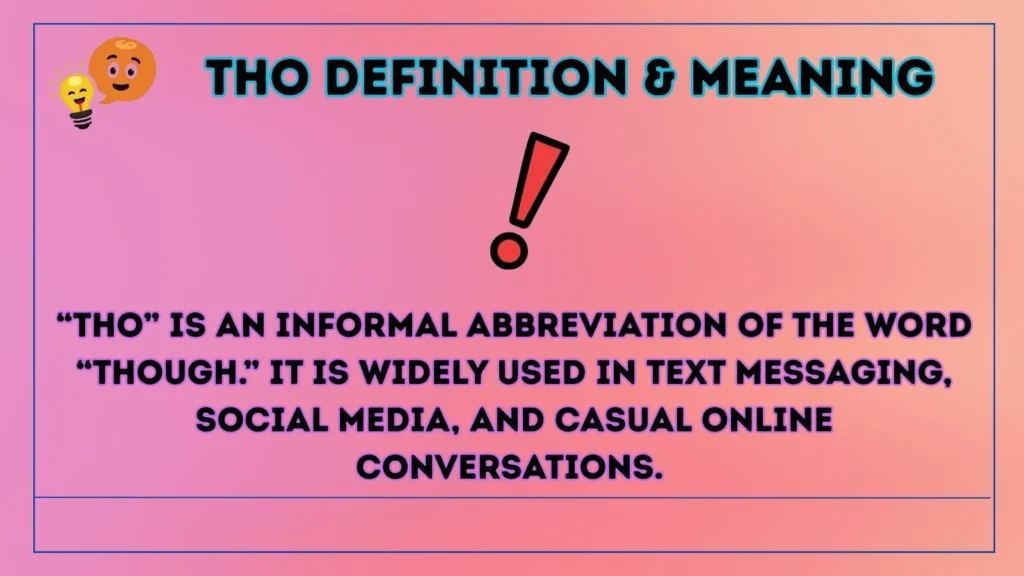
“Tho” is an informal abbreviation of the word “though.” It is widely used in text messaging, social media, and casual online conversations. Functionally, it often serves to:
- Introduce a contrast or exception.
- Emphasize a point at the end of a sentence.
- Add a casual, conversational tone.
Examples in sentences:
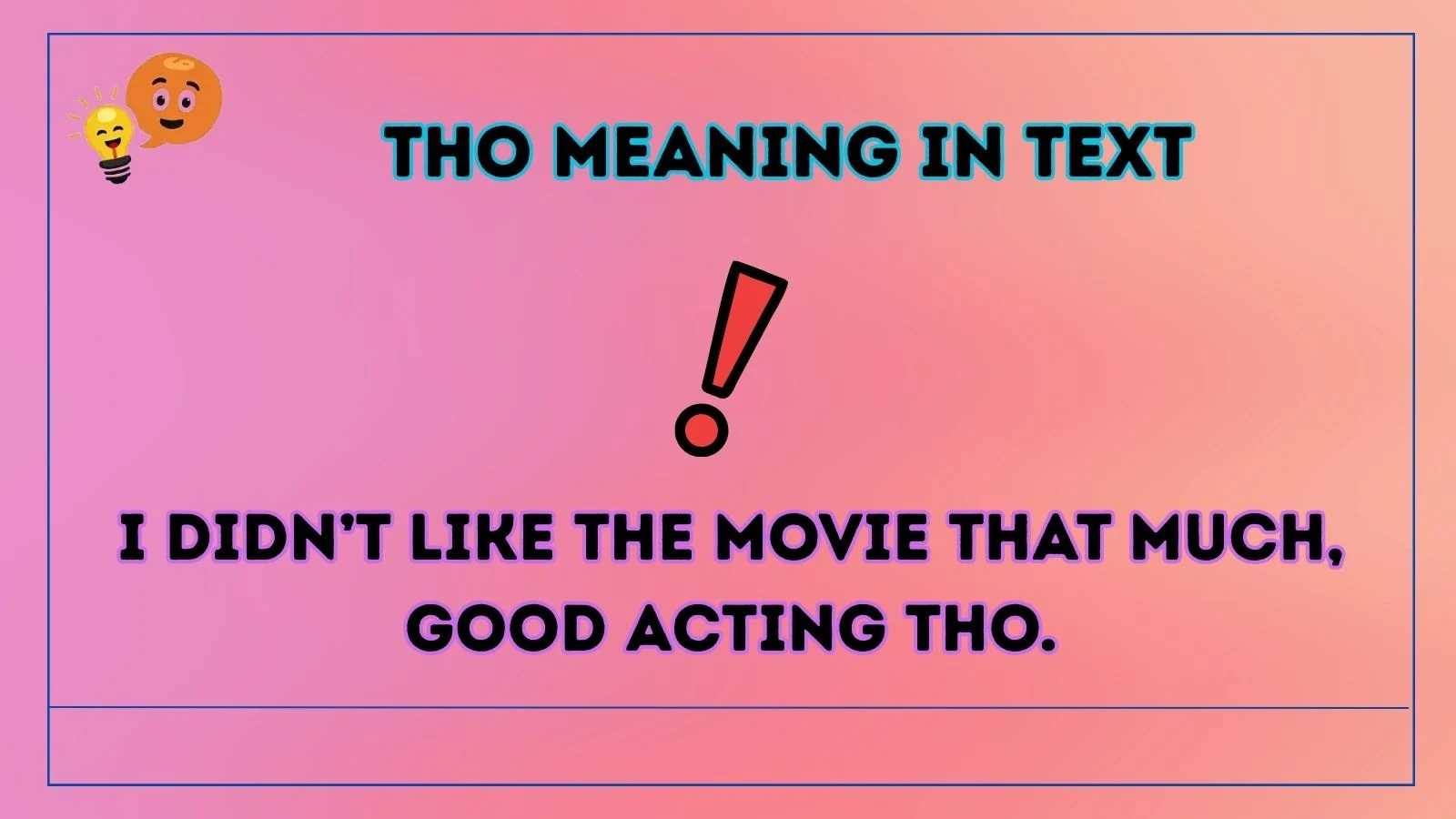
- “I didn’t like the movie that much, good acting tho.”
- “She’s strict, tho, she’s fair.”
Unlike its full form, “tho” conveys a laid-back or humorous tone, making it popular among younger audiences and in informal contexts.
Background & History
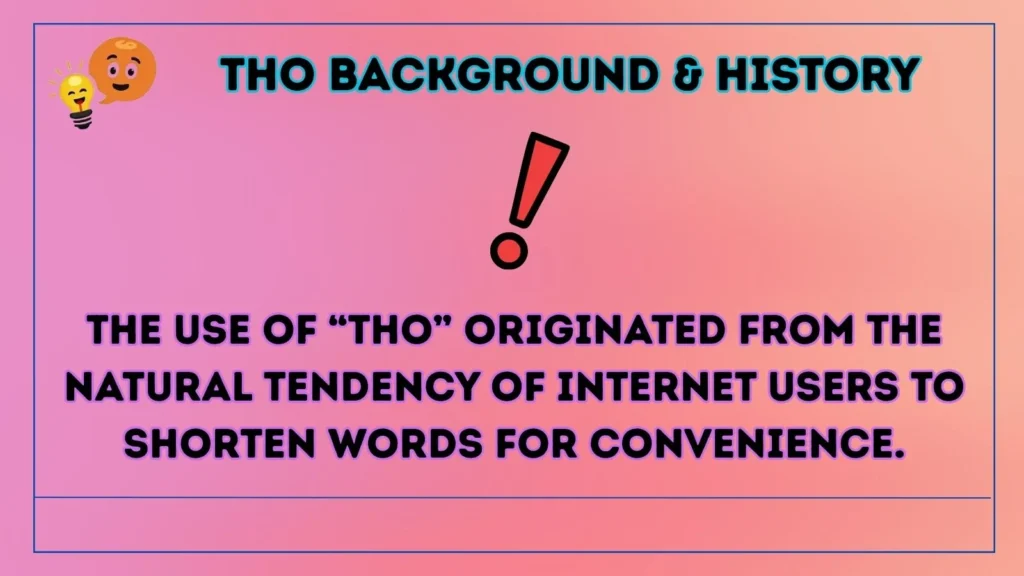
The use of “tho” originated from the natural tendency of internet users to shorten words for convenience. Early chatrooms, SMS messaging, and platforms like AIM and MSN Messenger encouraged brevity due to character limits. Over time, “tho” became standard in informal texting, social media captions, and memes. Its usage has expanded globally, with digital culture influencing how abbreviations are adopted across different communities. Today, it’s widely recognized by Gen Z, millennials, and even some older internet users, reflecting its staying power in online communication.
Usage in Various Contexts
Tho is versatile in casual communication. Some common contexts include:
- Text Messaging: Quick addition to a contrasting statement or point.
- Social Media: Often used at the end of a post or comment for emphasis.
- Memes & Humor: Adds a punchline or light sarcasm.
- Group Chats: Helps maintain a friendly, informal tone without being overly wordy.
It’s worth noting that while “tho” is casual, it may be misinterpreted in professional emails or serious conversations. Tone, audience, and platform are crucial for correct usage.
Common Misconceptions & Clarifications
- Misconception: “Tho” is a typo.
Clarification: It’s a deliberate shorthand widely recognized in informal contexts. - Misconception: “Tho” always replaces “though.”
Clarification: It’s often optional and sometimes added for emphasis rather than strict grammar rules. - Misconception: “Tho” is unprofessional.
Clarification: While informal, it’s context-dependent. In casual communication among peers, it’s perfectly acceptable.
Similar Terms & Alternatives
Several words or abbreviations share a similar function or tone with “tho”:
- Although – More formal alternative.
- But – Can introduce contrast in a simpler way.
- Anyways – Adds casual emphasis, often interchangeable in tone.
- Tho vs. Thx – Don’t confuse “tho” with “thx,” which means “thanks.”
Choosing the right term depends on audience, tone, and platform.
How to Respond to This Term
When encountering “tho” in conversation:
- Understand it often signals contrast or emphasis.
- Respond naturally; no special acknowledgment is required.
- Keep tone consistent; casual replies work best in informal chats.
Example:
- Person A: “I’m not a huge fan of pizza, tho.”
- Person B: “Really? I love it, especially with extra cheese.”
Regional or Cultural Differences
Tho is widely used in English-speaking online communities, particularly in the US, Canada, UK, and Australia. Its usage might be less common in non-English-speaking countries, where local abbreviations or slang may dominate. Cultural nuances influence how casual or humorous the term feels—some regions may prefer formal “though” even in casual text, while others embrace the shorthand fully.
Comparison with Similar Terms
Compared with “though,” “tho”:
| Feature | Though | Tho |
|---|---|---|
| Formality | Formal | Informal |
| Tone | Neutral | Casual, playful |
| Placement | Anywhere | Usually sentence-end |
| Usage in memes | Rare | Common |
Understanding these differences helps avoid miscommunication and keeps digital conversations smooth.
Usage in Online Communities & Dating Apps
On platforms like Twitter, Reddit, or dating apps:
- Tho can add humor, flirtation, or emphasis.
- It signals casualness and approachability.
- Frequently used in bios or status updates to soften statements or show personality.
Example:
- “I’m awkward, tho I promise I’m fun.”
Hidden or Offensive Meanings
Generally, “tho” has no offensive connotation. However, tone and context matter. Paired with sarcasm, criticism, or negative remarks, it can appear dismissive or passive-aggressive. Understanding context is key to interpreting intent correctly.
Suitability for Professional Communication
Tho is best avoided in formal emails, business reports, or professional messaging. While widely recognized in casual work chats (e.g., Slack, Teams), using the full “though” is safer for clarity and professionalism.
FAQs:
1. What does “tho” mean in texting?
It’s a casual abbreviation of “though,” often used for emphasis or contrast.
2. Can I use “tho” professionally?
It’s best avoided; use “though” for formal communication.
3. Where is “tho” most commonly used?
Social media, text messages, memes, and online chats.
4. Is “tho” offensive?
No, unless paired with negative or sarcastic comments.
5. How is “tho” pronounced?
It’s pronounced exactly like “though.”
6. What’s the difference between “tho” and “though”?
“Tho” is informal and casual; “though” is formal and standard.
Conclusion:
Tho may be a small, simple abbreviation, but it carries weight in casual online communication.
Its versatility in expressing contrast, emphasis, or humor makes it a staple in texting, social media, and digital chats.
Understanding “tho” ensures clarity, helps avoid misunderstandings, and keeps your conversations relevant in modern online culture.
By knowing when and how to use it, you can communicate with both style and ease, blending casualness with clarity depending on the context.

Root Pierce is a results-driven professional known for combining strategic insight with innovative thinking. With extensive experience in [insert industry, e.g., technology, business strategy, or marketing], Root specializes in developing solutions that drive growth, efficiency, and measurable impact. Renowned for a problem-solving mindset and collaborative approach, Root brings clarity, focus, and leadership to every project. His dedication to excellence, attention to detail, and forward-thinking strategies make him a trusted partner and influencer in professional environments.